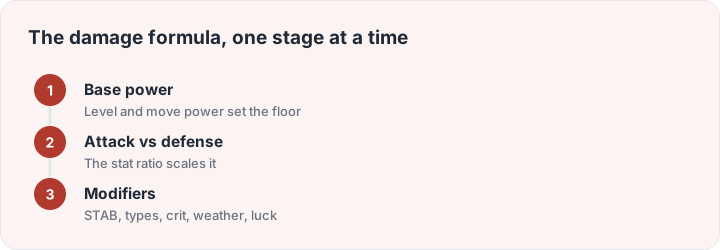
Every attack in the game, from a starter’s first Tackle to a championship knockout, runs through the same short pipeline. The official formula looks frightening in its full form, but it is four honest stages, and each stage has a plain-language job. Understanding the stages turns the calculator from a magic box into something you can reason about.
Stage 1: level and power set the floor
The formula starts with (2 × Level ÷ 5 + 2), multiplies by the move’s power, and folds in the attacker’s relevant stat against the defender’s matching defense — Attack against Defense for physical moves, Sp. Atk against Sp. Def for special ones. What this stage means in practice: a level 50 attacker with power 80 has a bigger starting pool than a level 25 attacker with power 60, roughly doubling for every 25 levels when stats are equal. This is why under-leveled teams feel helpless regardless of strategy.
Stage 2: the stat ratio is the lever
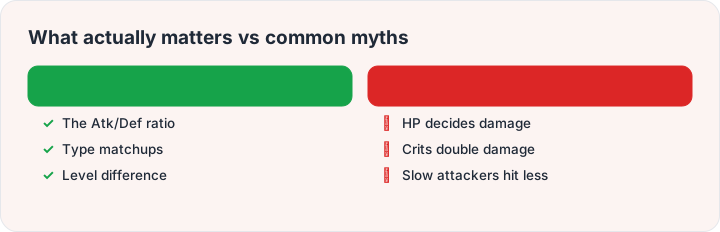
That attack-versus-defense ratio is where stats stop being abstract. Double the ratio, double the damage — so a tank with double the defense of the frail attacker next to it takes half the damage from the same hit. It also explains the most common beginner surprise: swapping in a defender with huge HP but poor Defense still melts to physical hits, because HP only decides how much damage counts as lethal, while Defense decides how big each hit is in the first place.
Stage 3: the multipliers stack
After the base number, the multipliers apply in sequence: STAB (×1.5 when the move’s type matches the attacker’s own — the quiet reason “use your own type” is decent advice), the type matchup against each defender type (×2, ×½, or the absolute ×0), criticals (×1.5, and they ignore your stat drops), weather (×1.5 for boosted elements, ×½ for weakened ones), and the attacker’s stat changes from moves like Swords Dance. Multipliers multiply: a STAB super-effective hit in the rain is not 150% better, it is 1.5 × 2 × 1.5 = four and a half times the neutral baseline — which is why the type chart outranks every other optimization.
Stage 4: everyone rolls the dice
Finally, the game multiplies by a random factor between 0.85 and 1.00 in sixteen steps. There is no such thing as a guaranteed damage number, only a range — the calculator shows both ends, and planning with the low end is the difference between a plan and a hope. The myths table below clears up the three most common wrong beliefs; the stats guide covers where the Stage 1 and 2 numbers themselves come from.