A team is not six favorite picks — until it survives a test, and then it is. This guide is the short path from “I like these” to “this has a plan”: three roles to fill, a weakness check, and a ten-minute pressure test using the tools on this site.
Step 1: the three roles
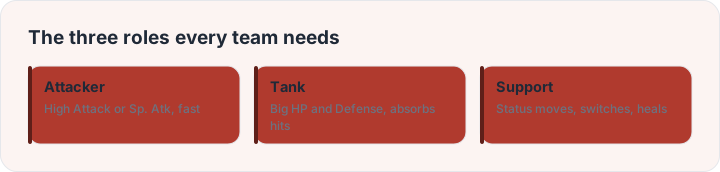
Nearly every functional team covers three jobs. An attacker — high Attack or Sp. Atk with the speed to use it. A tank — big HP and defenses, there to absorb the hits your attacker cannot. And a flex slot — the status moves, the resistances, the switch-in for whatever the first two fear. You do not need to name them in those words, but a team of six attackers is six coins flipped by whoever hits first; the losses that feel like bad luck are usually a missing role.
Step 2: cover the weaknesses
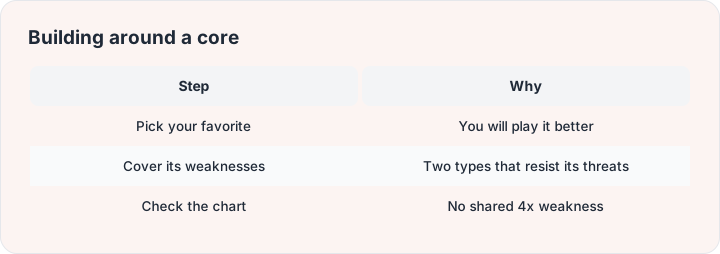
Open the type chart and list the attacking types that double into each member. Two rules do most of the work: no shared 4× weakness across the team (one puzzle piece everyone is missing gets exploited every game), and every common attacking type should be resisted by someone on the team. Resistances matter more than immunities for team building — an immunity is a wall for one move; a resistance is a wall for a whole playstyle.
Step 3: pressure-test with the calculator
Pick the scariest opponent you actually face. Enter your attacker’s real stats and the move you would lead with, then the opponent’s stats and types. Read the OHKO/2HKO line honestly: if your best hit needs three turns, the plan is not “attack harder”, it is either a stat change setup (the stat-change box shows what a Swords Dance buys you), a type advantage, or a different team member entirely. Ten minutes of this against two or three common opponents fixes more team problems than an hour of general advice.
Step 4: keep one slot you enjoy
The mechanical optimum that you do not enjoy playing loses to the slightly-off team you play well. Leave room for the favorite — the training levers can patch a favorite’s stats, and the roles can stretch around one sentimental pick. Teams are for playing, not for framing.